
See the setup differently
Hindsyt is developing a spatial intelligence platform that brings patient-specific 3D guidance, setup information and clinical context into the radiation therapy environment.
Designed by radiation therapy professionals, Hindsyt aims to help clinicians understand the setup in front of them while keeping the patient, workflow and clinical decision at the centre of care.
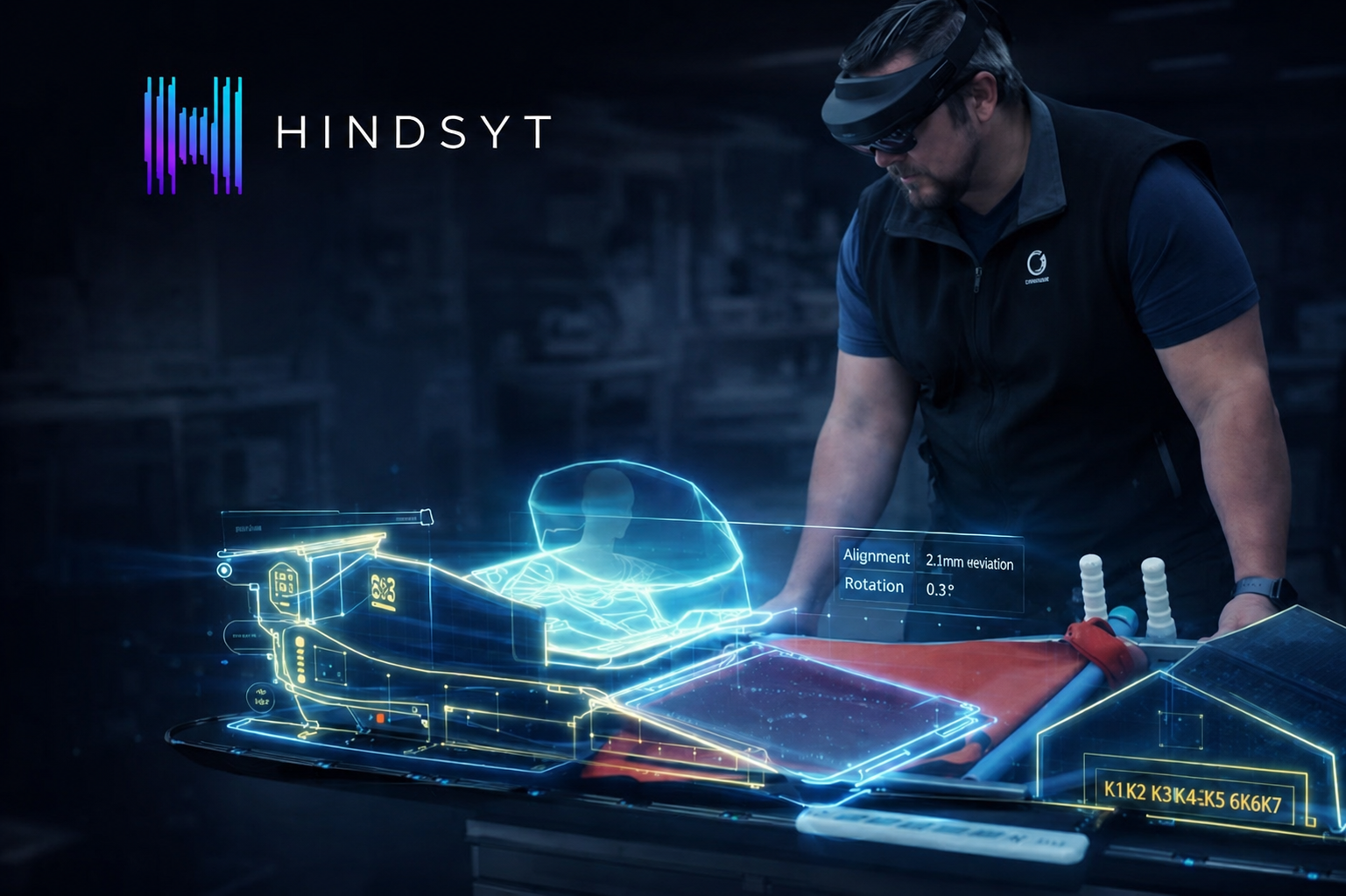
Visual. Connected. Clinician-led.
Patient-specific visualisation
Transform patient setup information into an intuitive three-dimensional reference that can be viewed within the clinical environment.
Context at the point of care
Present relevant setup guidance and workflow information within the clinician’s field of view, where decisions are being made.
Connected clinical workflows
Support continuity between simulation and treatment by carrying forward the spatial context of the original patient setup.
Complex setups need more than flat references
Radiation therapy teams routinely combine written instructions, photographs, measurements, imaging, immobilisation equipment and clinical experience to reproduce a patient’s position.
Each source provides part of the picture. Hindsyt is being designed to bring those elements together through a patient-specific spatial reference.
The objective is not to replace existing verification processes. It is to give clinicians an additional layer of information before and during setup assessment.
Designed around the realities of radiation therapy
See the patient-specific setup
Two-dimensional photographs and written instructions cannot always communicate the complete relationship between the patient, equipment and treatment environment. Hindsyt is being developed to create a three-dimensional reference of the established setup, giving clinicians a more intuitive way to review how the patient was originally positioned.
Recognise potential postural variation
Differences in shoulder position, spinal posture, pelvic rotation, limb placement or body contour may not always be immediately apparent. Hindsyt aims to provide visual comparison tools that can help clinicians identify areas that may require closer assessment.
Carry context from simulation to treatment
Important setup knowledge can become fragmented as the patient moves between simulation, planning and treatment. Hindsyt is designed to preserve relevant spatial context across the workflow, supporting clearer communication between teams and treatment sessions.
Keep information within reach
Clinical information is often distributed across monitors, documents and separate software systems. Through mixed reality, Hindsyt is being developed to display relevant information within the clinician’s working environment, reducing the need to repeatedly look away from the patient.
Support equipment awareness
Complex setups may involve multiple immobilisation devices, supports and treatment accessories. Hindsyt is investigating spatial mapping and object-recognition capabilities that could assist clinicians in reviewing the equipment expected for a patient’s setup.
Make expert knowledge easier to share
Experienced radiation therapists develop detailed visual and spatial judgement over many years. Hindsyt aims to help translate elements of that knowledge into consistent visual guidance that can support training, communication and workforce development.
From capture to clinical context
Capture
A patient-specific three-dimensional reference is created during simulation or another selected stage of the clinical workflow.
Contextualise
Relevant setup information, posture, equipment and workflow requirements are connected to the spatial reference.
Visualise
Mixed reality presents patient-specific guidance and contextual information within the treatment environment.
Assess
The clinician reviews the information alongside medical imaging, departmental procedures and their own professional judgement.
A spatial intelligence layer for the treatment environment
Patient-specific 3D reference
Visualise the established relationship between the patient, immobilisation equipment and treatment environment.
Postural comparison
Review regions of potential variation rather than relying solely on isolated reference points or general visual appearance.
Mixed reality guidance
Access relevant setup information within the clinician’s field of view while remaining engaged with the patient.
Equipment awareness
Explore methods for identifying expected accessories, supports and treatment-room objects within the setup environment.
Longitudinal context
Review how external posture and body contour may change across a course of treatment.
Workflow guidance
Present patient-specific prompts and information according to the stage of the clinical workflow.
Clinical education
Provide visual tools that may support staff training and help explain complex positioning requirements to patients.
Future anatomical context
Investigate methods for combining external spatial information with existing medical imaging to provide additional contextual insight.
Built to complement existing clinical systems
Hindsyt is not being developed as a replacement for medical imaging, treatment verification, clinical judgement or established safety procedures.
It is being designed as an additional visual and decision-support layer that helps clinicians bring together the information already required for patient setup.
The clinician remains responsible for reviewing the available information and determining the appropriate clinical action.
Designed by clinicians, for clinical reality
Radiation therapy environments are complex, time-sensitive and highly specialised.
Hindsyt is being developed with a focus on the principles that matter most at the point of care.
Backed by Leading Innovation Programs
Hindsyt is supported by prestigious accelerators, innovation programs, and technology partners driving the future of radiation oncology.

ACTIVATE Program
Selected for prestigious ACTIVATE fellowship program supporting breakthrough technologies

AUSCEP 2022
Australian Clinical Entrepreneur Program participant driving healthcare innovation

Microsoft for Startups
Official Microsoft for Startups partner with cloud and AI technology support
MedTech Actuator 2023
Graduate of MedTech Actuator Accelerator program for medical device innovation
More context. Less reconstruction.
Clinical teams should not need to mentally reconstruct a complex three-dimensional setup from disconnected pieces of information.
Hindsyt is developing a new way to see, understand and communicate patient setup across the radiation therapy pathway.
Not another screen.
A spatial intelligence layer within the clinical environment.
Development status
Hindsyt is a development-stage technology. The capabilities described are under development and remain subject to technical evaluation, clinical validation and applicable regulatory requirements.
Clinical safety, effectiveness and performance have not yet been established through completed clinical studies.
Hindsyt is not currently available for routine clinical use and is not intended to replace medical imaging, existing verification systems, clinical judgement or departmental safety procedures.